
Autism vs. ADHD: How Social Difficulties Differ in Children
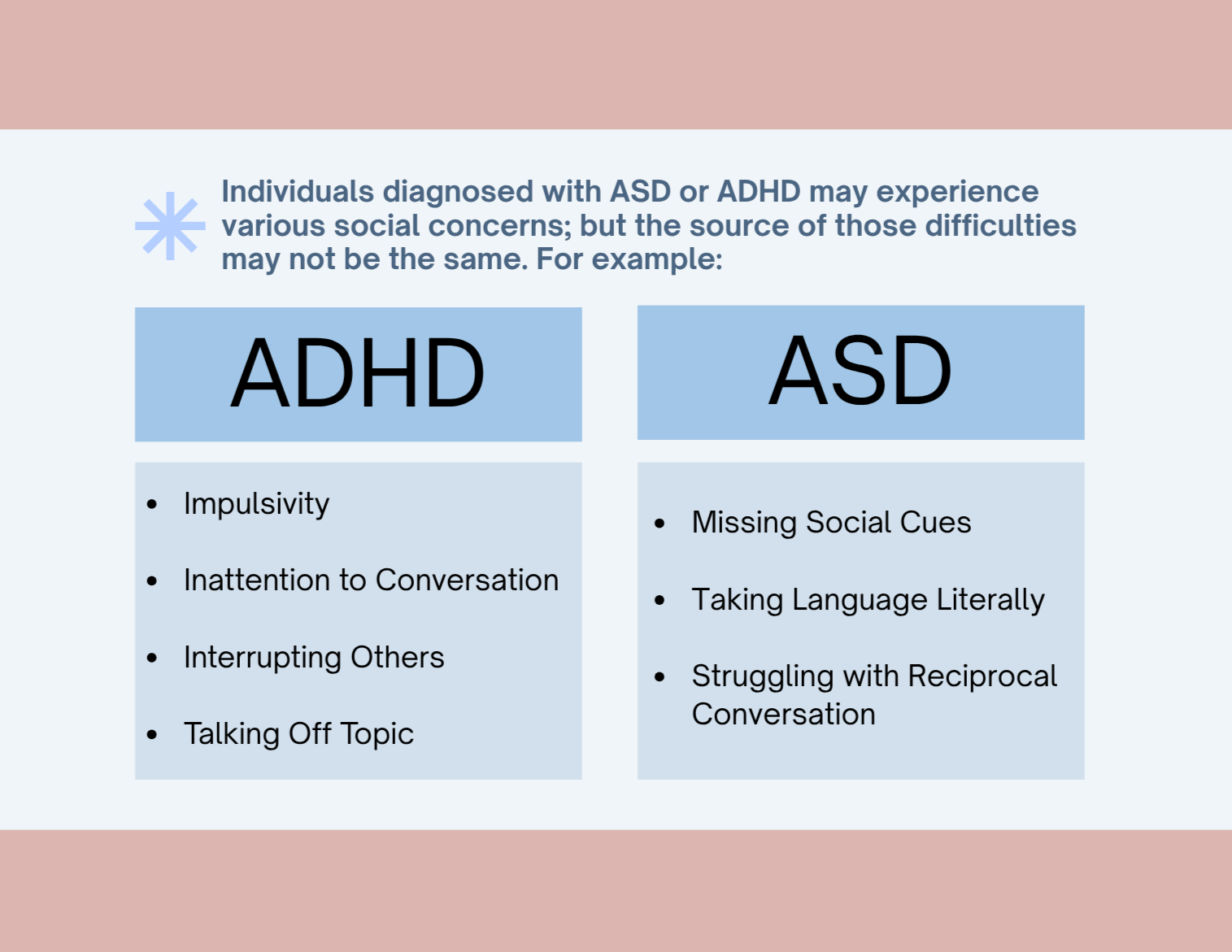
Many parents come in wondering whether their child’s social difficulties are better explained by autism, ADHD, or both. That question makes sense. Children with either profile may have trouble making or keeping friends, navigating group interactions, staying on topic in conversation, or responding smoothly in social situations. On the surface, these challenges can look similar. Research supports that there is real overlap. At the same time, the reasons underneath those difficulties are often not the same.
Autism spectrum disorder involves core differences in social communication and social interaction. These may include differences in back-and-forth conversation, social reciprocity, interpretation of nonverbal cues, understanding of unspoken social expectations, and the overall rhythm of interaction. These differences are part of the diagnostic core of autism, rather than simply a byproduct of distractibility or behavioral dysregulation.
ADHD can also affect social functioning in meaningful ways, but the pathway is often different. Children with ADHD are at higher risk for peer difficulties, including rejection, conflict, and unstable friendships. In many cases, these social struggles are more related to impulsivity, inattention, executive functioning weaknesses, and emotional dysregulation than to a primary difference in social understanding itself. A child with ADHD may understand social expectations, but have difficulty carrying them out consistently in real time.
This distinction can be useful clinically. In ADHD, the child may know what to do socially, but struggle with timing, inhibition, self-monitoring, or emotional control. For example, they may interrupt, shift topics abruptly, miss part of a conversation because attention drifted, or react intensely when frustrated. In these cases, the issue is often not a lack of social interest, but difficulty regulating behavior in the moment.
In autism, the difference is often more foundational to how social information is experienced, interpreted, and expressed. An autistic child may miss subtle facial expressions, interpret language more literally, have difficulty reading the unwritten rules of peer interaction, or prefer interaction that is more predictable, structured, or centered around shared interests. This does not mean autistic children are uninterested in connection. Many very much want connection, but may pursue it differently, or may find typical peer interaction harder to decode and respond to smoothly.
One reason families and providers can feel unsure is that the outward behavior may overlap. A child with ADHD and a child with autism may both appear socially awkward, say things that seem out of sync with the moment, or struggle to maintain friendships. However, research suggests that while children with ADHD can show significant pragmatic language and social communication weaknesses, the profile is not identical to autism and may reflect different underlying mechanisms.
It is also important to remember that autism and ADHD frequently co-occur. When they do, a child may have both genuine social communication differences and difficulty with attention, inhibition, and emotional regulation. In those cases, the social picture can be more complex, and support often needs to address both profiles rather than assuming one explanation accounts for everything.
From a clinical perspective, this distinction matters because it affects the type of support a child is likely to need. A child with ADHD may benefit from help with conversational pacing, emotional regulation, flexible responding, and awareness of how their behavior affects peers. An autistic child may benefit more from explicit support around social interpretation, perspective-taking, and navigating social environments in ways that are respectful of their neurotype and sensory needs. When we understand the why behind a child’s social difficulty, we can respond more accurately and more compassionately.
The goal is not to over-label every social struggle. It is to understand the child more clearly. Social difficulties in ADHD and autism can look similar from the outside, but they are often driven by different needs. Recognizing those differences can help parents, schools, and clinicians provide support that is more individualized, more effective, and more affirming.
If you have concerns about your child’s social development, a comprehensive evaluation can help clarify whether those challenges are more consistent with autism, ADHD, or another developmental profile — and guide the right supports moving forward.
References
Carruthers, S., Taylor, K., Sadiq, H., Gringras, P., Garnett, M., & Baird, G. (2022). The profile of pragmatic language impairments in children with ADHD: A systematic review. Development and Psychopathology, 34(5), 1938–1960.
Ferretti, N. M., Sathem, E. J., Katz, B., & Antshel, K. M. (2019). Social functioning in youth with attention-deficit/hyperactivity disorder: A systematic review and meta-analysis. Journal of Attention Disorders, 23(10), 1049–1067.
Hoza, B. (2007). Peer functioning in children with ADHD. Journal of Pediatric Psychology, 32(6), 655–663.
Hyman, S. L., Levy, S. E., & Myers, S. M. (2020). Identification, evaluation, and management of children with autism spectrum disorder. Pediatrics, 145(1), e20193447.
Kofler, M. J., Irwin, L. N., Soto, E. F., Groves, N. B., Harmon, S. L., & Sarver, D. E. (2018). Neurocognitive and behavioral predictors of social problems in ADHD: A Bayesian framework. Neuropsychology, 32(3), 344–355.
Chen, Q., et al. (2021). The effect of comorbid attention-deficit/hyperactivity disorder symptoms on children with autism spectrum disorder. Frontiers in Psychiatry, 12, 630550.